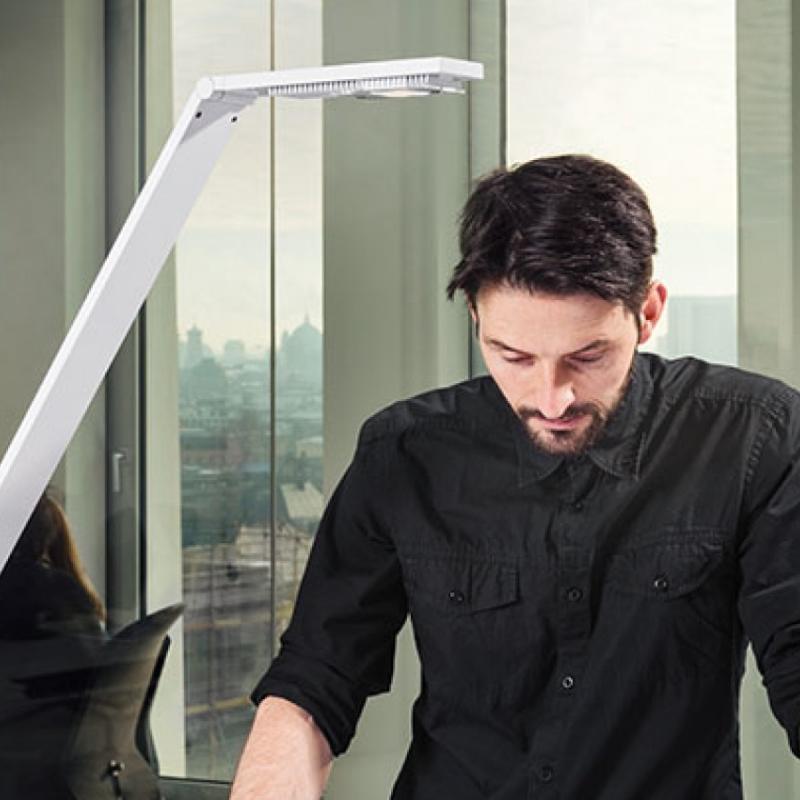
Choosing lighting for the office… A seemingly trivial task, but one that turns out to be much more important than it appears!
Every day, we expose our eyes to a large amount of information, which they analyse and transmit to our brain. Light plays a major role in this flow of information throughout the day. Whether natural or artificial, every ray of light emitted can cause physiological or physical changes that have a direct impact on our daily activities.
Beyond the desk and ergonomic chair, lamps must also be taken into account in the overall ergonomics of the workplace. Neon ceiling lighting, desk lamps, computer screen brightness, wall colour and the overall lighting atmosphere in your office are all elements that need to be reviewed if you think you are suffering from lighting-related problems.
Light, an exact science!
Various factors come into play when assessing the quality of light in your office:
- Lighting intensity
- The positioning of the luminaire and its direction
- Uniform lighting
- Possible glare
- Reflection on surfaces (walls, ceilings, floors, etc.)
- The temperature (colour) of the lighting
- The presence or absence of windows
How to measure the lighting in your office?
Although a comprehensive audit requires the assistance of a professional, it is still possible to measure the approximate light intensity of a room. To do this, there are numerous applications available directly on smartphones.
Light intensity (whether natural or artificial) is measured in lux. For an office environment, it is best to aim for between 300 and 500 lux. The more precision a task requires, the higher the lux level should be. For example, 1,000 lux can be achieved in industrial environments or laboratories. During the day, outdoor brightness can reach several thousand lux in sunny weather.
Benefits similar to light therapy
By ensuring good lighting in your workspace, you contribute to better visual comfort, which brings with it many positive effects: better working posture, increased concentration and productivity, good mood, fewer errors and less eye strain, better quality sleep, etc. Your technical and visual performance is therefore optimised.
Unfortunately, many companies do not pay enough attention to ergonomic lighting, which is essential, leading to long-term negative consequences for the well-being and productivity of workers.
Impact of poor lighting
Let’s take the example of an office with excessive artificial lighting, where it is impossible to see ‘normally’ without straining. Straining your eyes in this way can cause eye fatigue accompanied by vision problems, migraines or even eye irritation. Glare or lighting that is unsuitable for vision can also lead to compensatory movements and therefore poor working posture, resulting in musculoskeletal pain.
A l’inverse, dans un environnement de travail trop sombre, l’organisme, qui fonctionne au rythme de son horloge biologique, aura tendance à produire davantage de mélatonine, également appelée hormone du sommeil. Ce manque de lumière est donc la cause d’une fatigue ressentie plus importante, en plus des symptômes cités précédemment.
Good to know: the colour temperature of light also affects the biological clock. At the start of the day, natural light has bluish tones in its light spectrum. In the afternoon, this changes and takes on more red-orange tones. These are signals to the brain about the time of day and the rhythm associated with it.
Ergonomic lighting fixtures, a good compromise
When a building’s windows are small or few in number, and during the cold season, there is not enough natural light to regulate the body’s physiological system. There are two options available to you, which can be combined for best results: light therapy and ergonomic lighting.
At Wooh, you will find a wide range of ergonomic lamps to meet your specific needs. Depending on the layout of your workplace, there are various types of ergonomic lighting fixtures available: some distribute and diffuse light evenly, such as our Artemide models, while others reproduce the natural light cycle, such as our Luctra range. Using a smartphone or the touch screen built into the light fixture, you can adjust the lamp’s brightness throughout the day, as well as its colour temperature. This allows you to find the perfect settings for optimal comfort.
Would you like to find out more about our ergonomic lighting? Come and visit us at our showroom to discover our models.
In the meantime, discover our entire range of lighting fixtures. Lighting is an exact science!
Check that you have 3 or 4 fingers’ width between the back of your knee and the edge of the seat. If this is not the case, and you can adjust the seat depth, adjust it to achieve this 3 or 4 fingers’ width gap.
Why? If you have fewer than three fingers’ width between your knees and the edge of the seat, or if your knees touch the edge of the seat, you will create pressure behind your knees, which will prevent proper blood circulation and cause tingling or “heavy” legs. Conversely, sitting too far apart will put too much weight on your legs instead of relieving them.