
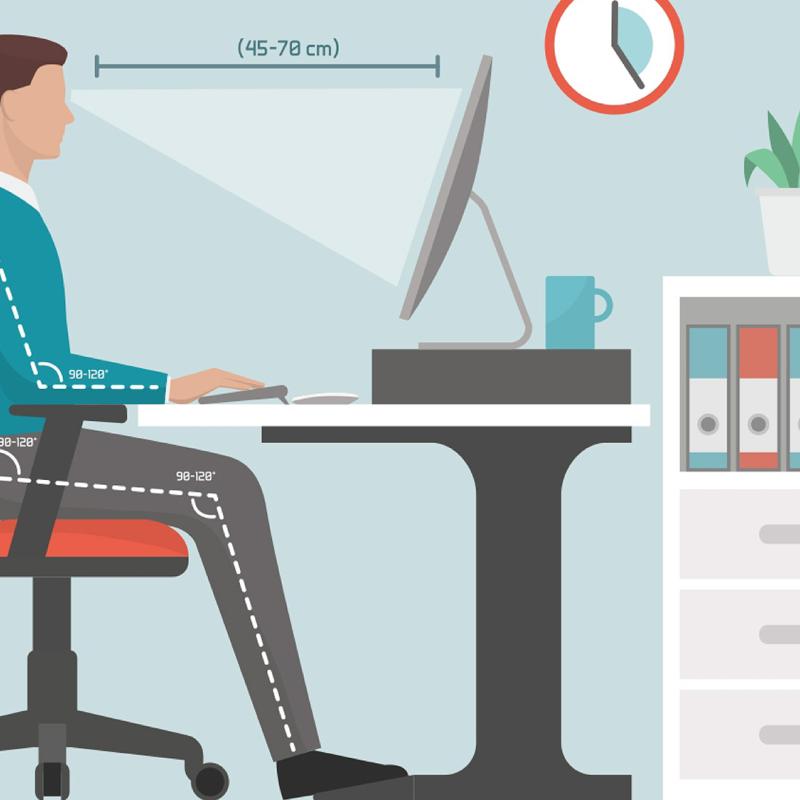
Sitting correctly in your office chair is essential for two reasons: concentration and physical health (back, shoulder, arm and neck pain, etc.).
If possible, opt for an ‘ergonomic’ office chair with the following features:
- Adjustable seat depth.
- Adjustable armrests.
- Seat height adjustment.
- Backrest angle.
Please note that the following settings must be made in the chronological order described below!
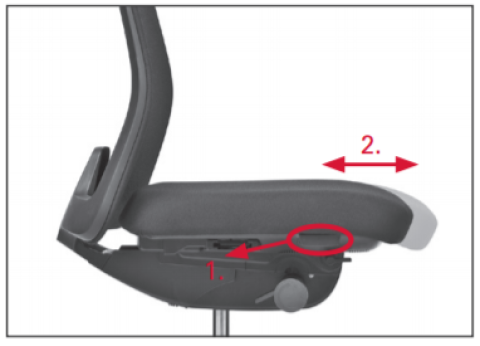
1. Start by sitting back in your seat with your back against the backrest.
Check that you have 3 or 4 fingers’ width between the back of your knee and the edge of the seat. If this is not the case, and you can adjust the seat depth, adjust it to achieve this 3 or 4 fingers’ width gap.
Why? If you have fewer than three fingers’ width between your knees and the edge of the seat, or if your knees touch the edge of the seat, you will create pressure behind your knees, which will prevent proper blood circulation and cause tingling or “heavy” legs. Conversely, sitting too far apart will put too much weight on your legs instead of relieving them.
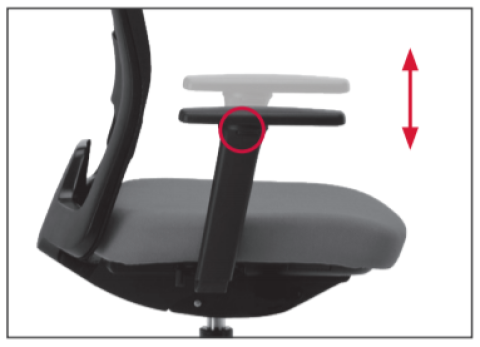
2. Next, make sure to raise your armrests so you can rest your forearms on them.
These should be positioned comfortably without creating tension in the shoulder.
Why? If the armrest is too low, tension builds up in the shoulder, which can lead to tension in the neck.
Also ensure that the armrest is aligned with the desk surface. If this is not the case, raise or lower the seat height. Again, this will prevent tension in the shoulders and neck, as well as pressure on the forearm from the edge of the desk.
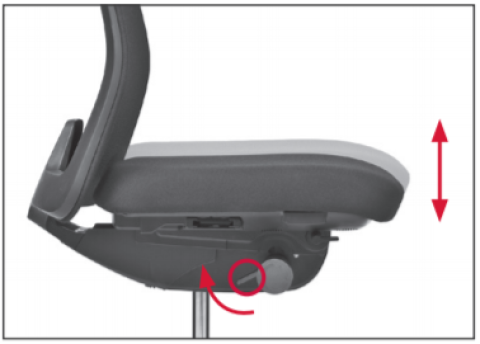
3. Once the seat height has been adjusted, ensure that the angle of your bent leg is exactly 90°.
However, there are two possible scenarios for obtaining a 90° angle:
- Conversely, you may need to raise your seat, while ensuring that the worktop and armrest remain aligned by adjusting the height of your desk. If your armrests are above the level of the desk top, the desk should be higher. An electric desk is the perfect solution.
- Either you need to have your feet higher than the floor, in which case you should use a footrest.
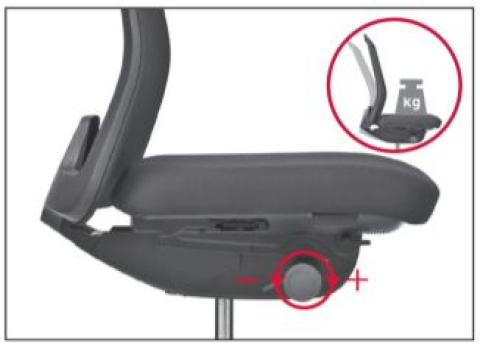
4. Finally, let’s finish with the tension of the dossier.
It is very bad to have a backrest that is locked in place (unable to tilt slightly forwards and backwards). Conversely, a backrest that is too flexible also alters your posture and exposes you to the same risks.
To adjust it, release the latch, which is usually located under the seat. Then lean back, stretch your arms out horizontally and raise your legs. Once you are in this position (although it may provoke some sniggers from your colleagues), gently bring both arms forward. If the backrest gently returns you to an upright position, it is correctly adjusted.
Is your chair returning a little too abruptly? Reduce its resistance using the wheel located under the seat.
On the contrary, does the tension of the backrest seem too loose? Tighten it. An acoustic solution does not mean completely ignoring the noise around us, but rather reducing the “background” noise and reducing echoes, whether at work with colleagues or at home due to large, open spaces with lots of windows.
Now you are sitting comfortably and ergonomically!