Office stools meet different needs from a traditional office chair. More mobile, often more compact and designed to encourage an active posture, they find their place in many professional spaces. Before choosing a model, however, it is important to consider several criteria, such as height, stability, adjustments or the type of use intended. On this page, Wooh helps you identify the stool best suited to your workspace and your habits.
Why choose an office stool?
The office stool takes a different approach from traditional seating. Unlike a classic office chair, it encourages a more active posture and the body’s micro-movements throughout the day. This greater freedom of movement makes it easier to alternate positions and limit long periods spent in a completely static posture.
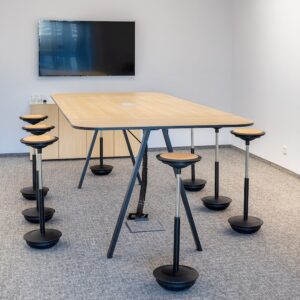
Office stools naturally find their place in environments where mobility is important: electric sit-stand desks, collaborative spaces, reception stations or light workshops. Their more compact design makes it easier to move around and offers more flexibility in organising the workstation.
Depending on the model, an office stool can also include ergonomic elements such as height adjustment, a tilting seat or a footrest. These features make it possible to adapt the seat to different users and work configurations while keeping the benefits of dynamic seating.
By taking these different criteria into account, you can select an office stool truly suited to the way you work. Beyond design, it is above all the adjustments, the stability and the quality of the seat that will make the difference day to day.
The best office stool is the one that naturally adapts to the way you work. By taking into account your environment, your habits and the time spent sitting, you can choose a model that encourages a more active posture without compromising your comfort.
-
Stools and high chairs
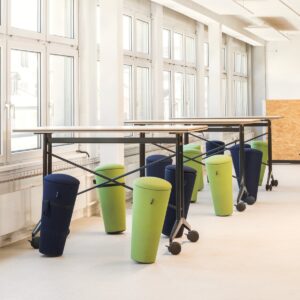
TWIST&SIT – Seat GT09 – Light green
Original price was: 552,00 €.358,00 €Current price is: 358,00 €. HTVA



Frequently Asked Questions – Office stools
What is the difference between an office stool and an office chair?
An office stool encourages a more active posture and offers greater freedom of movement than a conventional office chair. It is particularly well suited to roles requiring mobility or the use of a sit-stand desk, whereas a traditional chair is designed more for prolonged sitting.
Is an office stool ergonomic?
Yes, provided you choose a suitable model. Many office stools feature height adjustment, a dynamic seat or a footrest to encourage better posture and promote changes in position throughout the day.
Is it possible to work all day on an office stool?
It all depends on the model and how you work. An office stool is particularly suitable for people who regularly change position or use a height-adjustable desk. If you spend the whole day sitting down, an ergonomic office chair is generally a better choice.
Should you choose a stool with or without castors?
The choice depends mainly on your working environment. Castors make it easier to move around your workstation, whilst glides offer greater stability. Some models also allow for slight movement of the seat to encourage a more dynamic posture.
Is an office stool suitable for a sit-stand desk?
Yes, it’s actually one of the most common uses. Thanks to its height adjustment, the stool makes it easy to switch between sitting and standing, whilst maintaining an active posture and a good level of comfort.
Are an office stool and an office high chair the same thing?
The two terms are sometimes used to refer to similar types of seating. However, an office stool is generally designed to promote a dynamic posture and accommodate the user’s movements, whilst the term ‘high office chair’ refers more broadly to seating suitable for raised work surfaces or desks.
Ergonomic chairs
Executive chairs
Meeting chairs
Waiting-room chairs
Laboratory chairs
Office poufs
Back to the full guide: Professional office chairs