Why your desk’s position affects your stress levels at work
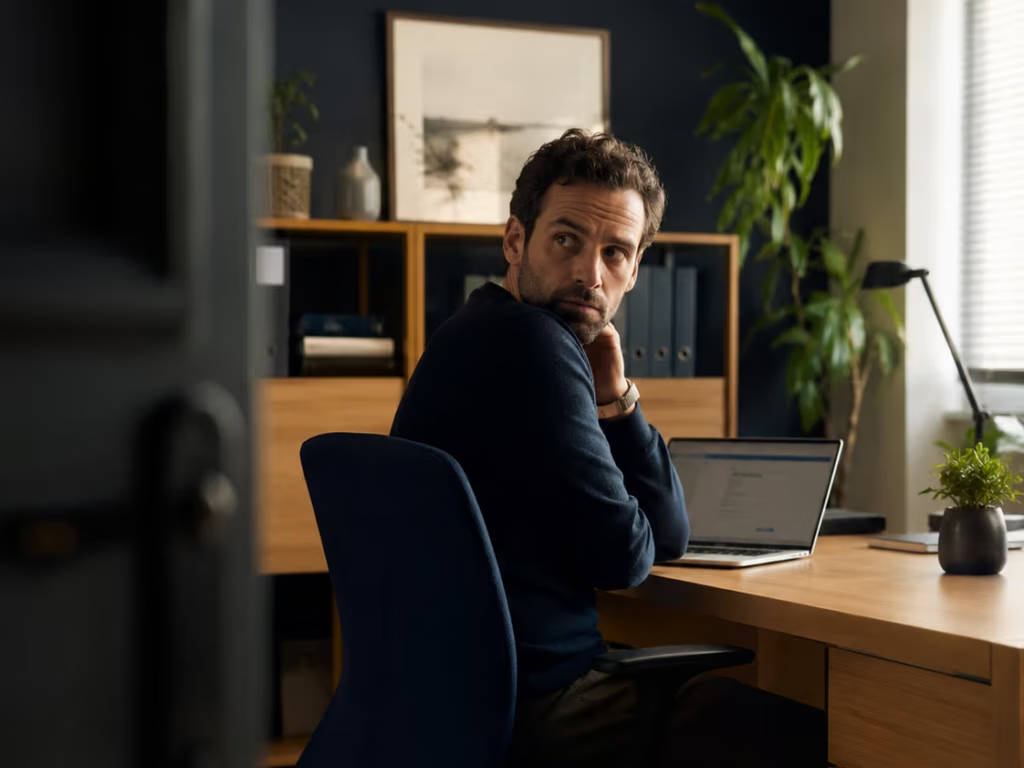
The position of your desk at work seems like a minor detail compared to the real sources of workplace stress: workload, deadlines and team dynamics. Yet the exact spot where you place your chair – and, above all, the direction you’re facing – triggers an age-old psychological mechanism that most office layouts completely overlook.
This mechanism has a name in environmental psychology: the prospect-refuge theory.
What the research says about the need to see without being exposed
The geographer Jay Appleton put forward this theory in 1975 in his seminal work *The Experience of Landscape*. His observation was that humans instinctively seek out positions that allow them to observe their surroundings (the ‘prospect’) whilst remaining protected from behind (the ‘refuge’). This instinct stems from an ancient survival need: to spot a threat before it takes us by surprise.
More recent research in environmental psychology has applied this theory directly to seating preferences in workspaces, confirming that a position offering both a view of the entrance and protection from behind is consistently preferred – and perceived as more comfortable – than the reverse. This finding is consistent with broader research into the link between perceived control and stress at work: employees who can adjust their seating position, lighting or immediate environment report lower levels of stress than those who have no control over their workstation.
To explore the basics in more depth, our article on why ergonomics is so important at work looks at other practical ways to improve wellbeing in the workplace.
The common misconception: a properly adjusted desk is enough
Many companies invest in ergonomic furniture – height-adjustable, with suitable seating – without ever questioning the orientation of the workstation within the room. The result: whole rows of desks facing a wall, a corridor or a bay window, with the entrance to the room in every employee’s blind spot.
The furniture may look perfect on paper. If the person sitting there never sees who enters their field of vision, a state of constant vigilance remains active throughout the day, without them realising it. It is not a question of how comfortable the chair is. It is a question of what the brain has to process in the background whilst the person is trying to concentrate.
How can you adjust the orientation of a workstation?
Position the desk so that it has an unobstructed view of the main entrance to the room. Even a three-quarter angle is enough to make you feel less exposed; there’s no need to be facing the door head-on.
Avoid having an employee’s back facing the main passageway. Areas with heavy traffic require far greater vigilance than secondary roads.
Use the furniture to create a sense of refuge. A high-backed chair, a low partition or a shelf behind the workstation can act as a backrest, even in an open-plan office.
Allow scope for customisation and adjustment of the role. The ability to adjust one’s own position enhances the sense of control, a factor in stress that has been documented independently of the orientation itself.
Reconsider the layout at the planning stage, not after the furniture has been installed. Once the posts have been wired and secured, correcting their alignment becomes a major job, whereas the issue can be resolved at an earlier stage by drawing up a site plan.
How Wooh is changing the way your workstations are set up
When undertaking an interior design project, Wooh’s team of interior designers takes these factors into account right from the layout stage, even before selecting specific pieces of furniture. The aim is not merely to make the most of the available space, but to position each workstation with a view to ensuring genuine psychological comfort, taking into account access points, circulation routes and sightlines.
This approach is reflected in the projects carried out by our design studio, where the layout is always decided before the furniture is chosen. It applies equally to open-plan offices and executive offices, where the question of positioning is just as critical.
Frequently Asked Questions
Is it absolutely essential to face the door to reduce stress?
No, precise alignment is not necessary. A three-quarter angle, with the subject entering your peripheral vision, is usually enough to reduce the feeling of being exposed.
What should you do if there is no room for any possible reorientation?
A discreet mirror, a higher chair backrest or a low partition behind the workstation can partially compensate for an orientation dictated by the building’s architecture.
Does this also apply to working from home?
Yes, the same principle applies to a home office. The positioning of the desk in relation to the door remains relevant, even outside a workplace setting.
How can you tell if the current direction is really a problem?
A simple sign: feeling tired at the end of the day to an extent that seems out of proportion to the actual workload may indicate a background state of alertness linked to the environment, including one’s orientation.
Sources:
A Prospect-Refuge Approach to Seat Preference: Environmental psychology and spatial layout
Appleton, prospect-refuge theory, “The Experience of Landscape”, 1975 — synthèse